6/7/2007 - Survival Spanish
by Rosemary Feal, Executive Director
Modern Language Association www.mla.org
ex-AFS Participant from the U.S to Guatemala
“Hola. Es Rosemary. Estoy aquí.” Those were my first words of survival Spanish, spoken into a pay phone in the airport in Guatemala City over thirty years ago. I distinctly remember choosing the third-person singular of the verb ser to identify myself, figuring if it was good enough for French (“C’est moi”), it would probably work in another Romance language. I had also learned that Spanish has a different “to be” verb for location and condition, and for that, I used the first-person singular. And I was just that: alone, at age sixteen, in an international airport with no one there to meet me, a piece of paper with my host family name and telephone number as my only guide.
The year I spent as an exchange student made me bilingual and gave me my future profession, and I must say that it was the foundational experience for my adult life. Yet I have never fully assimilated that extreme immersion phase, what amounted to an episode in “running abroad” (the respectable version of running away from home). It was only in talking with a colleague at a professional meeting in January, comparing notes on the foreign exchange student adventures we each had lived, that I decided to look back at that year. This is the first installment, and it’s not your usual editor’s column. I imagine, though, that all of you who studied abroad at a young age will know why these stories are worth remembering.
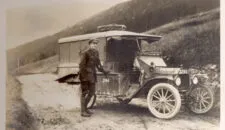
In the cold war days, being a foreign exchange student still retained the aura of serving as a kind of junior Peace Corps volunteer. The organization that sponsored my year abroad, the American Field Service (AFS), traces its origins to the battlefields of World War I (its mission was to transport wounded French soldiers), and between the wars it founded an exchange program that connected American and French university students. After World War II, AFS furthered its tradition of world understanding and service through new cross-cultural educational exchanges. With encouragement from the State Department, AFS started a program that involved students from former “enemy nations” such as Japan and Germany. AFS currently promotes values that reflect and update cold war rhetoric: the organization purports to enable “people to act as responsible global citizens working for peace and understanding in a diverse world,” and it “seeks to affirm faith in the dignity and worth of every human being and of all nations and cultures” along with “respect for differences, harmony, sensitivity and tolerance” (The AFS Mission)
How I longed to be that kind of cultural ambassador for my country . . . in France. I was all set to respect the diversity of the French people, whose language I had learned quite well in my secondary school. I dreamed about perfecting my understanding of all things French (I had already spent a summer in Europe that included a month of study in Montpellier). Had I been a teenager in the 1980s, I might have had that choice. The mentality that dominated in the cold war period, however, allowed for no such free election. This wasn’t about personal enrichment, after all: you were off to represent your nation. Once you were selected to be an exchange student, you were assigned to a country for your American field service much as if you had been in the reserve army corps.
And so the envelope arrived in late fall that year, announcing that I would depart in early January to spend a calendar year in Guatemala (why couldn’t it be French Guiana, at least?). My family and I consulted an atlas. Let’s see; it’s in Central America, right near Mexico. Language: Spanish (well, in reality, about half the population speaks Indigenous languages such as Kaqchikel, Mam, and Poqomchi, something I was to learn firsthand when I spent time in the upper Quiché region). There was much more to discover about the distant and more recent history of Guatemala. When I received news of my student exchange assignment, I ignored the existence of the Popol Vuh, I had never heard of the United Fruit Company, and I had no clue that the ambassadors of the United States and of Germany had been assassinated in the preceding two years and that civil liberties in Guatemala had been suspended.
“¡Es Rosemary, la estudiante de los Estados Unidos!” I don’t remember exactly what happened next. Someone on the other end of the phone must have spoken to me in English, told me to stay put at the airport, and come to gather up the unexpected gringa, the first exchange student to Guatemala for a school year, and the only one. I had faith that people were expecting me, that I would be taken care of in my foreign journey, even though I was also prepared to fend for myself to the degree that a sixteen-year-old can. What little orientation I had been given took place during a two-night stay in New York on my way to Guatemala, in a place near the United Nations building where I mixed with kids going to and coming back from all over the world. We heard phrases like “culture shock” and “period of adjustment,” and we were told to be flexible, adaptable, and to act like good Americans who could sacrifice the comforts of a typical teenage existence for the greater goals of international harmony and the like. Instructions on what to do if no one meets you at the airport would have been useful.
My impetuous entry into my host family’s home accomplished, I began an intense course in acculturation as I observed my new surroundings. I was surprised to see that there were servants in the household and that they wore Indigenous clothing, which I would later learn to call by name (the corte, the huipil). No one talked to the servants except to bark orders. They lived in a tiny room on the roof, the cuarto de azotea. The parents in the host family ran a small shop in the front of the house, and the son was a dentist whose office was in the family residence. The daughter had spent a year in California as an exchange student and was fluent in English and well versed in American ways. She was a high school graduate who worked for the Guatemala tourist office. She was my interpreter in all senses, assigned to help the gringa fit in. It turned out to be a task that was too big for both of us.
Strange, this gringa. She doesn’t have pierced ears (the mother in the family promptly pierced them for me herself, with needle and thread). She’s skinny (pero si no come nada). She laughs too loud; she’s so direct (¡qué bruta es!). Yes, and strange, these Guatemalans. They claim they are españoles, but their Indigenous (or mestizo) heritage is as clear as can be. They are critical of the United States while at the same time they envy the level of material wealth they think all Americans enjoy. I couldn’t understand them, linguistically or culturally, yet I knew it was my job to adjust, to be adaptable.
I didn’t know what the father in the family was asking me when he said “¿Tienes naipes?” “¿Cómo?” (My usual reply.) “¿Tienes barajas?” he asked, using a synonym. He pantomimed dealing a hand, but still I didn’t get it. “Cards,” said my Malintzin.
Dumb gringa. Each morning someone asks me, “¿Qué tal amaneciste?” I figured out I was supposed to say bien, but I really wished I knew what that word was. I looked up manesiste and amaneciste and a mano ciste: no help. When I finally discovered that I was dealing with the preterit tense of amanecer in the second-person singular (familiar), I felt a great sense of relief. Ah, it means “how did you dawn”! How did I dawn? How did I wake up? What a strange way of asking “How are you this morning?”
Things got a lot better when I finally started school a few weeks later at the single-sex Catholic high school, the Instituto Belga Guatemalteco. The nuns gave me the next lessons in my cultural education. “Your skirt is too short,” the Madres told me. (That pantomime was executed clearly.) You have to get a uniform. “Tienes que tienes que tienes que.” Their English was limited; my Spanish was still under construction, so we did the best we could. I was never sure I had understood the latest “tienes que,” but when I got to French class, I had no trouble with “ouvrez vos livres à la page quinze.” What a relief. I bombarded the Mère of the moment with my uncertainties (“Que veut dire ‘tienes que je ne sais quoi zapatos planos’?”), and I got the answers I needed. “Ah,” she said. “Pourquoi n’avez-vous pas dit que vous connaissiez le français?” I’d finally found my survival Spanish, and it had come from France after all.
This article has been reprinted by permission of the Modern Language Association of America from “Survival Spanish,” MLA Newsletter pages 5-6
photo: Rosemary Feal, Executive Director, Modern Language Association