Newsimg-185

7/21/2006 - Journey Back: An AFS Driver’s Memories

Written by Arthur Williams (FR 4)
On May 10th, I returned from a seven-day trip to places in countries where I had been 62 years ago as a young AFS volunteer ambulance driver with the French First Army in a French Moroccan Mountain Division during World War II. My sons, Nate and John, thought that their dad, approaching a significant birthday, might like to retrace his steps through Europe where he served in 1944-45. My boys knew I was lousy tourist who would rather look at a good glass of wine than stained-glass windows. They were right!

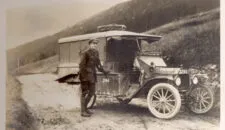
In both world wars, AFS supplied ambulance drivers to Allied armies. I cannot say that I was that patriotic, but I knew the cause was just and that the Germans and Japanese had to be defeated. But for me, at the time, I felt that I would rather have faced the entire German army than my high-school biology teacher. So I found myself on a ship plowing through the stormy North Atlantic in November to Naples, Italy and then on to southern France, with a group of young Americans, some new to this and some having served in North Africa with the British and French armies.

In May of 2006, armed with information and maps from AFS archives, we flew into Zurich and drove to the beautiful town of Feldkirch, Austria where we started our trip in reverse from where the war had ended for me. My 1944 trip had started in St. Remy in France, where we were quartered in the one-time asylum where Van Gogh had cut off his ear. After two weeks on hard floors with no heat and little plumbing, I was ready to cut off more than my ear to get out of there.

In Feldkirch in May 2006, I tried to locate two once-young girls I had become good friends with at the end of the War. After much searching, we stopped at the tourist office where a nice woman got on the phone and was able to speak to the younger brother of one of the girls. He remembered that when he was 12, I was the American with the French Army who had driven him and his friends around in a jeep and given them his chocolate ration. Unfortunately, his sister had recently died.

We then headed up through the Black Forest where we had evacuated allied and German wounded. I remember being ordered to evacuate prisoners in a concentration camp who were just left lying there in their striped pajamas; nothing but vacant stares and voices that said little. The German guards had fled the camp hours before the allied advance. With the help of a fellow AFS driver, Ned Kelley, I found a hotel that had been a German hospital in 1944 just outside of Freudenstadt and Baden-Baden. It was now serving as a youth hostel.

After our usual wine and beer stops, the boys and I spent the night in Baden-Baden, known for its mineral water baths. Fellow drivers visited some of these baths in April 1945 attended by helpful employees who were friendly to our soldiers even though the war was still on. The closest I came to being taken prisoner was when I agreed with a French medical officer to load some badly wounded Germans in my vehicle and allow a German army doctor to ride in front with me to find the German hospital and enter enemy territory. An armed Moroccan soldier rode in back of my ambulance. Unfortunately, he fell asleep as soon as we started and stayed that way for most of the trip. The medical staff invited me to stay for dinner, probably because they were surprised to see a young American with the French Army. The Germans were friendly; they knew the war was just about over and didn’t show hostility. It was pouring rain when I returned to the ambulance, which became stuck in the mud in spite of four-wheel drive. The Moroccan soldier was still asleep. The German doctor with me went into the hospital ward and came out with ten or more sick or wounded solders and ordered them to lift up my ambulance out of the mud and place it on the road.


Arthur at youth hostel near Baden-Baden,
Germany which had been a field hospital in 1944.

The next day on the 2006 revisit, we left Baden-Baden and crossed the Rhine below Strasbourg to Colmar where there was a military museum representing the long and bloody battle to recapture Colmar where the German army, in one last desperate attempt to stop the Allies, broke through the allied forces’ front lines in the Ardennes Forest in the Battle of the Bulge. German soldiers who spoke good English had obtained uniforms from prisoners or dead Americans. Because of this deception, American MPs would make American soldiers prove who they were by asking us questions such as who played third base for the Dodgers. They could not have asked a less-informed sports fan than me. AFS drivers were somewhat suspicious looking because we sported an assortment of allied uniforms. One man with me was even wearing a pair of German army-issue “jack boots” he had picked up somewhere, but that was not what you wanted to be wearing when checked by American MPs.

On May 7 we spent the night at Vieux Thann, near the Belfort Gap in the Vosges Mountains of eastern France, where I had spent a week or two in December 1944 in a makeshift aid center in the mountains.

The next day May 8th V.E. day (Victory in Europe Day) our first stop was Vieil Armand, and from there we took off over a mountain road that I had traveled in 1944 at night through the ice and snow with no headlights, carrying the wounded and many other soldiers whose feet were blackened by frostbite. One time, my ambulance skidded and dangled over a cliff. My assistant had dislocated his shoulder, so I had to pull the stretchers out one by one being very careful not to rock the ambulance off the cliff with the wounded and me inside. On top of this mountain pass, which led to a hospital in a town called Masevaux, there is now a monument 200 yards off the road erected to the French Paratroopers of WWII. In the rain and fog, my sons and I heard music from the valley below celebrating VE day and honoring those who had died.

After spending the night near Besançon, we headed back to Zurich for our flight to Boston. This trip to the past brought back many memories, and reminded us what a toll war takes no matter the cause, not only on the soldiers but the innocent civilians.

(I would particularly like to thank AFS archivist Eleanora Golobic for all her help in planning our trip. She sent me transcripts of journals kept by AFS veterans who served with the First French Army—Maj. Charles Coster, Lt. Warren Fugitt and Sgt. “Bud”Roberts; thus I was able to compare their records with my recollections. Also, my friend Ned Kelley, who served with me in the 3rd Battalion of the 4th French Moroccan, reminded me of where we had been and what had happened in certain localities. I am also grateful to the staff of AFS France for their support with the trip.)

Top photo: Arthur (sixth from left upper row) with the French Section 3, Feldkirch, Austria, May 1945.