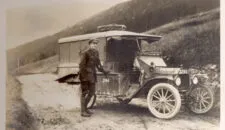
Chaung crossing north of Sinthe in Burma in the spring of 1945. Photograph by DeWitt Morrill. Item found in RG2/002, the AFS World War II Photographic Collection. This image cannot be reproduced without permission from the Archives of the American Field Service and AFS Intercultural Programs.
This picture shows American Field Service (AFS) ambulances crossing a chaung (stream bed) north of Sinthe in Burma during the spring of 1945. Between December 1943 and April 1944, 812 AFS ambulance drivers were stationed in the India-Burma theater of war.
The first AFS ambulances used in this theater of war were black Fords, made from ¾ ton chassis with a white circle containing a red cross painted on the sides. According to DeWitt “Dick” Morrill, an AFS World War II Ambulance Driver and the photographer of the image above, the rear axles of these vehicles broke frequently. In 1944 AFS began using black Chevy trucks that were slightly larger than the Fords. The Chevy truck chassis were made in Canada and were then shipped to Bombay (present day Mumbai), where the ambulance bodies were constructed. Both the Ford and Chevy trucks contained an unusual characteristic for the American volunteers: the driver seat was on the right side of the vehicle. It was only in the spring of 1944 that AFS also began using olive-colored Jeeps that were issued by the United States military. These were smaller and lacked a passenger seat and windshield, though the driver seat was once again placed on the left side. The Jeeps officially accommodated only two stretchers and one sitting patient, though the AFS drivers would sometimes place stretchers on the hood of the vehicle and carried seated passengers on the bumpers or the hood, if needed.
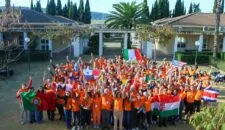
AFS Participants from different regions of the world smile during their arrival orientation at the C.W. Post Campus in Long Island, NY (USA), 1973. Item found in RG4/001, the AFS Student Programs Collections. This photograph cannot be reproduced without permission from the Archives of the American Field Service and AFS Intercultural Programs.
The picture depicted above shows five AFS Participants from different regions of the world sharing a happy moment during their arrival orientation held at the C.W. Post Campus of Long Island University in Brookville, NY, near New York City.
The C.W. Post Campus holds an important place in AFS history, since thousands of participants spent their first or last days of their AFS exchange program in the United States there. In the past, participants would arrive to the Campus from their countries of origin for orientation, during which they would meet other students and be involved in social activities such as cultural talent shows and other group games. American students would also gather there before leaving for their destinations abroad. Beginning in 1982, international participants from the nearby region also returned to the C.W. Post Campus at the end of their stay to attend Departure Day, after which they would begin their journey home. While the orientation events are held elsewhere today, the C.W. Post regional Departure Day tradition is carried on, thanks to many AFS volunteers and staff members who contribute to it every year. In June 2012, more than 700 students arrived at C.W. Post, where they spent several hours together before heading to the airport and the end of their AFS Participant experience.
Ambulance 255 donor card. RG1/001, the American Field Service World War I Records. This photograph cannot be reproduced without permission from the Archives of the American Field Service and AFS Intercultural Programs.
This ambulance donor card was kept internally by the American Field Service (AFS) in order to monitor and track the specifics of each donated ambulance during World War I. AFS led large-scale fundraising efforts during the war, and many individuals and organizations donated funds for the purchase of ambulances. Donors were then sent unique certificates of service, which included details about the AFS section the ambulance was placed into.
Funds for this particular ambulanced were donated by the Groton School in Groton, Massachusetts, in 1916. Thirty-two students and graduates from the Groton School volunteered for AFS during the war, which likely contributed to the school's desire to donate. The Groton Ambulance was given the number "255" by AFS and "32020" by the French military, and was placed with Section Sanitaire [États]-Unis (SSU) 8. The driver was Massachusetts native Oscar Anthony Isaigi, a chemical engineering graduate from the Massachusetts Institute of Technology.
Though the original no longer exists, the AFS ambulance numbered 255 was recently reconstructed as part of a private project, using an original ambulance chassis and the same wood and hardware used to construct the original. The reconstructed ambulance was featured in the AFS World War I event at Beauport, AFS World War I staff member Henry Sleeper's historic home, in June 2012, as well as in U.S. President Barack H. Obama's second inaugural parade in January 2013.
AFS ambulance drivers with two Italian children, one holding a box of chewing gum on February 4, 1944. Photograph by Loftus B. Cuddy, Jr.. RG2/001, the AFS World War II Photographic Collection. This photograph cannot be reproduced without permission from the Archives of the American Field Service and AFS Intercultural Programs.
The Allied forces in World War II launched an amphibious landing in the areas of Anzio and Nettuno on January 22, 1944, against German forces during the Italian Campaign in what’s referred to as “Operation Shingle.” Despite the initial and successful element of surprise, the Allies were unable to quickly consolidate and send reinforcements for an offensive attack, and the Battle of Anzio against the Axis powers dragged into the summer months. Two American Field Service (AFS) ambulance sections of D Platoon, 485 Company, were assigned to take part in the amphibious landing. The drivers practiced loading and unloading ambulances from tank landing ships and waterproofing their ambulances prior to the operation. The sections were joined by additional AFS ambulance drivers after landing and throughout the ensuing battle, all helping to evacuate the high number of casualties.
The photograph depicted above features two Italian children, one holding a box of chewing gum given to him by AFS ambulance drivers Bernie Curley and Richard Decatur. The photograph was taken by fellow ambulance driver Loftus B. Cuddy, Jr. near the beachhead established in Anzio. The two children were found wandering along the beachhead, and were later taken to a safe camp where civilians who were caught in the invasion of Anzio waited until they could be evacuated.
Holiday card designed by AFS student Jaroslava Moserová (CZE-USA, 1947-1948; 1948-1949) and first distributed in 1949 for the benefit of AFS International Scholarships. This item can be found in RG4/001, the AFS Student Programs Collection. This photograph cannot be reproduced without permission from the Archives of the American Field Service and AFS Intercultural Programs.
This holiday card, which was sold to raise funds for the American Field Service International Scholarships Program, was designed for this purpose by Jaroslava (Jara) Moserová, (CZE-USA, 1947-1948; 1948-1949). It depicts a group of children on a sleigh, gliding down a snowy mountain and holding flags from multiple countries. The card was first distributed in 1949, shortly after Jara returned from the second year of her AFS exchange program in the United States.
Jara participated in the first post-war AFS program in 1947-48, when she attended the Warren Wilson College in Swannanoa, North Carolina. While she was studying at the Art Students League in New York City during her second year abroad, the Communist regime that had been established in her country made the presence of AFS there impossible, and the organization ceased to exist for nearly half a century. After the Velvet Revolution in 1989, Jara contacted AFS and actively helped regenerate the organization in Czechoslovakia. When the country peacefully split in January 1993, Jara founded AFS Czech Republic (AFS Mezikulturni programy, o.s.) with two other Returnees from the 1947-1948 program year. To learn more about Jara’s fascinating life, visit the Web site for AFS Czech Republic here.
Undated postcard depicting the American Ambulance Hospital at the Lycée Pasteur in Neuilly-sur-Seine, France. RG1/002, American Field Service World War I Photographic Collection. This photograph cannot be reproduced without permission from the Archives of the American Field Service and AFS Intercultural Programs.
Veterans Day is an American federal holiday honoring veterans of all wars on November 11th each year. Initially, this holiday was known as Armistice Day, which commemorated the signing of the armistice ending wartime hostilities on the Western Front during the First World War. In honor of this holiday celebrating the “end” of the war, this month’s post is about the “beginning” of AFS, which today serves as an organization that provides intercultural learning opportunities to help people develop the knowledge, skills, and understanding needed to create a more just and peaceful world.
The American Ambulance Hospital in Neuilly-sur-Seine, depicted in the postcard above, was the original location of the organization that became known as the American Field Service (AFS.) The American Hospital of Paris, established before the outbreak of war in 1914, used the unfinished Lycée Pasteur as their military hospital (also referred to as an “ambulance”) to accommodate a larger number of patients. A. Piatt Andrew, a former director of the United States Mint, set sail for France in December of 1914 in order to volunteer with the hospital, and later became Inspector General of their Transportation Committee. In 1915 Andrew convinced the French army to let the ambulance drivers of the hospital work closer to the front lines of battle. His organization of drivers, known initially as the American Ambulance Field Service, broke away from the hospital in 1916 and established an independent headquarters in the heart of Paris for the remainder of the war.
Robert Montgomery with sculptor and World War I veteran Stuart Benson in Paris, France. June 1, 1940. Photograph by Acme (Paris). This photograph cannot be reproduced without permission from the Archives of the American Field Service and AFS Intercultural Programs.
This image shows Hollywood movie star Robert Montgomery standing with fellow ambulance driver Stuart Benson in front of an American Field Service (AFS) ambulance in Paris, France. Montgomery (born Henry Montgomery, Jr.) was an American actor, Academy Award nominee, and former President of the Screen Actors Guild before volunteering as an ambulance driver with AFS in June of 1940. He drove an ambulance in France and was engaged in evacuating wounded soldiers to Vouvray when Paris fell to Germany, and consequently returned home to the United States that same year. Montgomery toured California to raise funds with AFS World War I camion driver Whitney B. Wright (TMU 133), and joined the U.S. Navy Reserve as an officer for three years before the war ended.
After World War II Montgomery made his directing debut with the film Lady in the Lake (1947), became a consultant and coach to President Dwight D. Eisenhower on his broadcasts to the nation, and also created the Emmy Award-winning television series Robert Montgomery Presents (1950-1957). Montgomery’s daughter, Elizabeth, made her television acting debut on her father’s television show, and later starred as Samantha Stephens in the television comedy Bewitched.
AFS Participant Marketta Mattila (FIN-USA, 65-66) with her host family in Huntington Beach, California (USA), 1965. Register Photo found in RG4/001, AFS Student Programs Collection. This photograph cannot be reproduced without permission from the Archives of the American Field Service and AFS Intercultural Programs.
The picture shows Marketta Mattila (second from right), an AFS Participant from Kankaanpää, Finland, standing with her new host family on the day of her arrival in Huntington Beach, California, in 1965. Marketta was beginning a full school year as an exchange student with the Royers, and her host parents and sisters received their “new” member of the family with big smiles and a welcoming banner.
In 1948, the first AFS students from Finland (three from secondary schools and one from college) traveled to the United States as part of the Year Program. AFS Finland began hosting American students for an entire school year when the Americans Abroad Year Program was established in 1957. By 1965, when Marketta was hosted by the Royer family, there were fifty-nine Finnish students who spent a full school year in the United States, while three American students spent a school year living in towns in Finland.
Click here to read about a current American student’s experience living and attending school in Finland, posted on the AFS-USA Study Abroad blog. To view other photographs of AFS students being welcomed by their new host families, check out the pictures recently posted on the AFS Canada, AFS Sweden, and Intercultura (AFS Italy) Facebook pages.
A Little Morning Exercise- Philip Glorieux of SSU 9 boxing the French mechanic, 1917. Photographer unknown. RG1/002, American Field Service World War I Photographic Collection. This photograph cannot be reproduced without permission from the Archives of the American Field Service and AFS Intercultural Programs.
This image shows Philip Glorieux of Irvington, NJ, boxing an unidentified French mechanic one morning in 1917. Glorieux served alongside the French military as an American Field Service (AFS) ambulance driver for six months during World War I.
Glorieux’s ambulance section, Section Sanitaire [États-] Unis (SSU) 9, first came into existence on August 14, 1916. The section first left for the Vosges Mountains in France from Versailles, near Paris. The men of SSU 9 later drove ambulances to their poste de secours on the Meuse River at Montgrignon near the front of Verdun, the site of the longest and one of the bloodiest battles of World War I. After Verdun, the section moved to different locations in France and ended at Saint-Max outside of Nancy, where it was taken over by the United States Army Ambulance Service (U.S.A.A.S.) as a new unit, SSU 629. Glorieux was one of the men who joined the U.S.A.A.S. after the United States entered the war in 1917.
Newton C. Estes of A Platoon, 567 Company, jumping over the bar in the high jump competition, 1945. Photograph by Carl Zeigler. RG2/002, American Field Service World War II Photographic Collection. This photograph cannot be reproduced without permission from the Archives of the American Field Service and AFS Intercultural Programs.
Toward the end of World War II, American Field Service ambulance drivers in 567 Company were stationed at an embarkation camp in Pisa, Italy, awaiting movement orders. The ambulance drivers coordinated a two-day track and field meet that included a high jump, running and wheelbarrow races, and a tug-of-war competition between the different platoons of 567 Company during this period of inactivity. Directly following the meet, 567 Company received orders to embark for France aboard an LST, a ship meant for transporting vehicles and personnel.
This photograph shows Newton C. Estes of A Platoon jumping over the bar in the high jump competition. More photographs of the two-day track and field meet can found in Carl Zeigler’s photographic album in the American Field Service World War II Photographic Collection. This album can be viewed during a scheduled research appointment in the AFS Archives.
AFS students holding signs representing their home countries in Point Park, atop Lookout Mountain Battlefield in Chattanooga, TN, July 1948. Photograph by Carl Zeigler. This photograph cannot be reproduced without permission from the Archives of the American Field Service and AFS Intercultural Programs.
Over sixty years ago, AFS exchange students embarked on the first AFS bus trip across America before departing back to their home countries. The purpose of the tour was to give the students a fuller picture of the United States, to help them know and understand the country so that they could work abroad for international understanding, and to interest American citizens in providing scholarships and hospitality for more international students each year. World War II ambulance driver Carl Zeigler and his wife contacted Greyhound Lines, which donated a bus and a bus driver for the trip.
The bus trip consisted of twenty-nine students from France, the Netherlands, Norway, Czechoslovakia, England, Greece and Syria. The students were selected from the larger group of fifty college and secondary school students who had arrived ten months earlier from ten foreign countries as part of the first post-World War II AFS exchange program. The bus trip was a twenty-four day, 5,500 mile adventure that covered twenty-two states. Stops along the way included the White House, the Ford assembly plant in River Rouge, the Seven Falls of Colorado, and a baseball game in Chattanooga, TN. The students had a $0.75 allowance per day, and used this money to purchase findings along the way, including chocolate bars and soda from vending machines.
To read more and see other photographs of the trip, including a photograph of Eisenhower with the AFS students, download the October 2007 issue of the AFS Janus here. This issue contains an article (pp. 8-9), written by World War II ambulance driver DeWitt Morrill, who served as a spokesman and chaperone on the first bus trip.
(Left) The cook at Villa le Querci, the American Field Service convalescent depot in Florence, Italy, ca. 1944-1945. (Right) American Field Service Drivers at the Villa le Querci, ca. 1944-1945. Photographs by Irving Penn. RG2/003, Irving Penn Photographic Collection. These images cannot be reproduced without permission from the Archives of the American Field Service and AFS Intercultural Programs.
Twenty minutes outside the historic city center of Florence, Italy, stands the Villa le Querci. Situated among the oak trees for which it was named, the Villa became a destination for the advancing American Field Service (AFS) during World War II. The AFS arrived at the Villa in August of 1944—a little more than a week after the Germans destroyed all the bridges crossing the Arno River in Florence except for the Ponte Vecchio- and eventually converted it into the official convalescent depot associated with the AFS Liaison Office in Florence.
Official AFS records from the war indicate that a number of Italian civilians lived in the Villa at this time, including thirteen year-old Danila Frassineti and her fifteen year-old brother, Giordano. Their mother Helen, an American citizen, had been sent to a concentration camp and then released to live in the United States prior to the arrival of AFS at the Villa. Because Danila and Giordano were Italian citizens, they had not been taken as prisoners and were left under the watch of servants and family friends. Helen requested help from the U.S. Consul of Florence to arrange to have AFS move into the upper part of the Villa, where they stayed until July of 1945.
In 2011, Danila contacted the AFS Archives to discover if she could find any information about her childhood home in Italy. For information on Danila’s experience with AFS during the war or to view more photographs of the Villa found in the AFS Archives, read the article entitled “Villa le Querci: A Young Woman’s Wartime Memories of AFS” on pages 6-7 of the Spring 2012 issue of the AFS Janus here.
Convoy of chassis coming back from Le Havre, France, March 1915. Photographer unknown. RG1/022, Regis H. Post Correspondence. This image cannot be reproduced without permission from the Archives of the American Field Service and AFS Intercultural Programs.
This photograph depicts a convoy of chassis coming back from the docks at Le Havre in France. The chassis arrived from the United States and were driven to the American Ambulance Hospital in Neuilly, which was the parent organization out of which the American Field Service was formed during World War I.
The photograph accompanied a letter written by Regis H. Post to his mother on March 24, 1915, from the Department for the Wounded at the Hospital. Post describes the photograph in his letter, and notes that the "railroads are so congested that we send our own men down to Havre, unpack the cars on the docks, assemble them, have a rough box built on them, and push them home along the road."
More wartime letters written by Post can be found in his collection in the AFS Archives.
Bill Congdon holding a ceramic platter in Faenza, Italy, 1945. Photograph by Carl Zeigler. RG2/002 AFS World War II Photographic Collection. This image cannot be reproduced without permission from the Archives of the American Field Service and AFS Intercultural Programs.
William “Bill” Congdon was an American Field Service ambulance driver who served in the African Campaign in the Western Desert, Italian Campaign, and the France-Germany
Campaign during World War II. The photograph depicted above was included in a two-volume photographic album compiled by Carl Zeigler, a World War II ambulance driver and staff photographer for the American Field Service. Zeigler’s original caption for the photograph is as follows:
Congdon Helps Revive Famed Faenza Art...
Bill Congdon of D Platoon worked with the Allied Military Governor of Faenza and the civilian Red Cross on local relief work. This old city, long famous for Faenza pottery and ceramics, had lost practically all of its kilns and shops during the month-long shelling of the city by the 8th Army. The pottery makers were desolate and believed the art would never be revived. But Congdon, who is a painter, etcher and sculptor, searched out surviving examples of Faenza ware from the ruins of homes and cellars where they had been hidden for safekeeping, and staged an exhibit. This huge platter, in greens and purples and yellows, was purchased by Congdon for 5000 lire, and other Field Service men bought similar museum pieces. The Faenzians took heart and said they thought they would get going again.
Congdon’s appreciation for art continued after the war, when he became an influential painter of urban landscapes and religious themes. His artistic legacy is featured in a new exhibition entitled “The Sabbath of History: William Congdon- Meditations on Holy Week, ” running from February 22- September 16, 2012 at The Knights of Columbus Museum in New Haven, Connecticut. More information on the exhibit can be found on the AFS Archives News Updates page.
AFS Participants performing a local dance called “Seng-ka-tib-kaw” in Thailand, October 1981. Photographer unknown. This image cannot be reproduced without permission from the Archives of the American Field Service and AFS Intercultural Programs.
This photograph depicts AFS Intercultural Programs Participants performing a local dance called “Seng-ka-tib-kaw” from Northeast Thailand for a television program performance in October of 1981.
AFS Thailand sent their first group of students to the United States in 1962 under the supervision of the Ministry of Education and the Ministry of Foreign Affairs with support from the United States Information Service. Today, AFS Thailand is an international organization, sending and hosting students to and from countries around the world with the help of around 3,500 volunteers and eighty chapters throughout the country.
AFS Thailand celebrates its fiftieth anniversary this year, and will host the AFS World Congress in Bangkok from February 7-11, 2012, for over 200 staff, volunteers, chairs, board members, and partner directors from around the world.
Sidney C. Howard standing in front of an American Field Service ambulance in Alsace, France in 1916. Photographer unknown. RG1/019, John C. B. Moore Collection. This image cannot be reproduced without permission from the Archives of the American Field Service and AFS Intercultural Programs.
This photograph of famous playwright and screenwriter Sidney Coe Howard (1891-1939) was taken in France during World War I, and was found in John C. B. Moore’s wartime scrapbook. Howard joined the American Field Service as an ambulance driver in June of 1916. He was sent to Alsace, France with SSU 9 until December of 1916, when he joined the newly-formed SSU 10 unit serving with the French Army of the Orient in the Balkans. Howard later joined the French aviation units following the militarization of the American Field Service in the fall of 1917.
Howard was the author of many plays throughout his career, including “Labor Spy,” “Yellow Jack,” “The Silver Cord,” and “Paths of Glory,” and won the 1925 Pulitzer Prize in Drama for “They Knew What They Wanted.” In addition to being nominated for the screenplays of “Arrowsmith” and “Dodsworth,” he won a posthumous Oscar in 1939 for writing the adapted screenplay of “Gone With the Wind.” Howard died in a tractor accident on his Pennsylvania farm at the age of forty-eight, four months before the premiere of the film.

The AFS Letters was a monthly publication containing letters from World War II ambulance drivers, copies of which were sent to the AFS headquarters on Beaver Street in New York City by their friends and parents. The issues were compiled by Dot Field and included correspondence describing the daily activities of the drivers and their experiences in the Middle East, North Africa, India, Burma, Italy, France, and Germany.

This particular issue of the AFS Letters was sent during the holiday season in 1943. The cover includes a photograph of AFS ambulances aboard an LST (which transported vehicles and personnel), and the first page contains a letter from Director General Stephen Galatti, who reminded those at home of the sacrifice their sons and husbands were making to help wounded soldiers during the war.
Photographer unknown. This image (and any others on the website) cannot be reproduced without permission from the Archives of the American Field Service and AFS Intercultural Programs.
This photograph of current AFS President Vincenzo Morlini was taken on the S/S Seven Seas in August of 1966, when he sailed from Rotterdam to New York as an AFS Winter Program Participant. On this particular night the students wore their clothes backwards for a party on the ship. The guitar Vincenzo is holding belonged to Franco Bernabé, a fellow Italian student on the program who now serves as the CEO of Telecom Italia.
Stay tuned for the upcoming Fall 2011 issue of the AFS Janus, which includes this photograph and a letter from Vincenzo. Click on the play button below to listen to Vincenzo's recent conversation with former AFS President Tachi Cazal.
Photograph by PP/Photocenter. This image (and any others on the website) cannot be reproduced without permission from the Archives of the American Field Service and AFS Intercultural Programs.
This photograph depicts a group of AFS Returnees participating in a kickline during the International AFS Weekend held in Antwerp, Belgium, from September 13 -15, 1974. Over 300 AFS Returnees flocked to the Belgian “Tent City” for the gathering, which was held on the site of a former mine field from World War II. The program was coordinated in conjunction with the AFS European Conference, and included a forum with then-President Steven Rhinesmith, workshops on encouraging involvement in AFS in the respective homelands of the Returnees, and a dance celebrating the 25th anniversary of the AFS Belgium office.
For other historic photographs of AFS Returnees, Particpants or World War II Ambulance Drivers dancing, visit the news feature on the AFS-USA partner website located here. For information about the U.S. Department of State’s “Dance with Us: Motion Across Cultures” photograph competition for AFS government-sponsored program Returnees, visit their website here.
Photograph by Dr. John C. (Jock) Cobb. This image (and any others on the website) cannot be reproduced without permission from the Archives of the American Field Service and AFS Intercultural Programs.
This photograph is part of a series Dr. John C. (Jock) Cobb developed while in Tunisia, which depicts the methods of "desert" medicine in North Africa during World War II. This particular image, which can also be found in the American Field Service World War II Photographic Collection, features an orderly preparing for an operation by lighting the primus stove to boil the sterilizer. The floor of the operating tent is covered with canvas to prevent the sand from blowing around during the operation.
Cobb recently published a photographic narrative of his time spent as an ambulance driver and official staff photographer with the American Field Service during the war. The book, entitled Fragments of Peace in a World at War, consists of photographs from Syria, North Africa, and Italy from 1942-1944, and includes other images from his "Desert Medicine" series. More information about the book, including purchase information, can be found here.
This image (and any others on the website) cannot be reproduced without permission from the Archives of the American Field Service and AFS Intercultural Programs.
Named for Captain Richard Mallet, the Réserve Mallet was the collective name for the series of units known individually as Transport Matériel [Etats-] Unis (TMU), which were engaged in the transportation of munitions and supplies for the French during World War I. Though somewhat controversial at the time, Director General A. Piatt Andrew recruited American Field Service men for these camion units under the belief that they should serve France in whatever ways necessary in order to help the war effort.
The Archives of the American Field Service and AFS Intercultural Programs (AFS Archives) contains several collections from World War I Drivers who were members of a TMU unit, including the Edward H. Pattison Collection and the Ralph E. Ellinwood Collection. The original recruitment poster (pictured above) is stored with the American Field Service World War I Records.
Photo by Abby Rowe - Courtesy of the National Park Service
This photograph shows President John F. Kennedy walking to the microphone before addressing AFS students at the White House in July 1961. Kennedy spoke to AFS students in Washington, D.C. three times during his presidency, including in July of 1963, when he met them on the South Lawn of the White House. Kennedy commended the American Field Service for their activities as a voluntary ambulance organization during World War II, and addressed the students directly about their role in creating a more peaceful world.
To listen to an audio clip of President Kennedy's speech from July 1963, click the play button below.
In this clip from a Legacy Project interview completed in 2002, Arthur Howe, Jr. discusses his time spent on the Egyptian tourist ship that transported his ambulance unit (ME 2), 80 Canadian nurses, and other individuals helping the British military (often in civilian roles) from New York City to the Middle East in January 1942.
The ship hugged the coast due to the threat of German military submarines (U-boats), and broke down or needed repairs several times before finally reaching Port Tewfik, their final destination at the north end of the Red Sea.
Oral History Collection, Archives of the American Field Service and AFS Intercultural Programs